Tuesday, 25 November 2008

Sunday, 23 November 2008
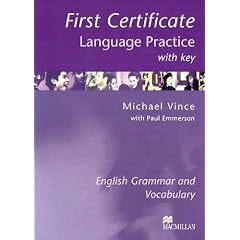
NA1 Resources: Grammar & Vocabulary Correspondence
Hi all,
If you want to check the correspondence between the coursebook (First Certificate Expert) and the grammar & vocabulary book (First Certificate Language Practice), please download and print out the following document.
Let me remind you that the book First Certificate Language Practice is compulsory and you should be using it autonomously as we progress throughout the course.
See you around.
.
Pronunciation: Difficult English words (I)

Hiya!
I thought it might be interesting to include in the blog some pronunciation exercises. Just read aloud the listed words and check their pronunciation using one of the many different online audio dictionaries available.
Here's the first exercise:
Disappearance of vowels
family - garden - Edinburgh - awful - evil - interest - history
French words
moustache - bizarre - repertoire - memoire - reservoir
decade, parade, tornado, crusade
Alternations of some vowels
clerk (both BrEng and AmEng) - clerical - Berkshire
campus
compass - borough, conduit, love, conjure
quarrel - quantity
wagon - woman - wolf - bosom - womb - tomb - who - whose
fault - coughing - Australia - author
lost - cross - golf
sugar, rule, lucid, crew, blew
Culture: British habits and conventions

HINT: Triple-click in the spaces to see the answers
In Britain...
1. What might you say when someone sneezes?
Bless you
2. What could you take to someone's house when you are invited for dinner?
Usually a bottle of wine. Flowers or chocolates are also acceptable.
3. What do you say before a meal?
British people don't usually say anything.
4. What might you say when you are introduced to someone?
Hello / Pleased to meet you / Lovely to meet you.
5. What could you say when someone tells you they have failed their driving test?
What a pity/Better luck next time/Never mind, I'm sure you'll pass next time.
6. How might you refuse an invitation politely (e.g. 'Would you like to go to the cinema tonight?')
I'd love to, but I'm afraid I'm... / Sorry, but I'm...
7. You have cigarettes but no matches. What might you say to a stranger?
Excuse me, have you got a light?
8. You need a seat in a café. There is a table with three seats but only two people sitting there. What could you say to them?
Excuse me, is this seat free? / Is anyone sitting here?
9. Who would you give a tip to?
Waiter, taxi driver, hairdresser
10. Name three situations where British people would queue.
Bus stop, shop, cinema, public toilets, buying tickets
11. Name three festivals celebrated in Britain.
Christmas, New Year, Easter, Hallowe'en, Bonfire Night, Valentine's Day
12. Give two alternative ways of saying 'goodbye'.
13. What do you say if you stand on someone's foot?
Sorry
14. What could you say if someone tells you they are going to get married?
Congratulations!
15. What might you say before you have a drink (e.g. in a pub)?
Cheers!
16. What do you say to your colleagues on Friday as you leave work?
Have a nice weekend! / Enjoy your weekend! / See you on Monday!
17. What do you say to someone who is going to do an exam?
Good luck!
18. What do you take to a party?
Something to drink, normally alcoholic.
19. What should you say if you want to get past someone's who's in your way?
Excuse me / Could I just get past?
20. What do you say to a friend if you want to borrow their car?
I was wondering if it would be possible to borrow your car.
21. When you visit someone in their house, is it good manners to take your shoes off?
Only if they are dirty.
22. 'It's your round.' What does it mean?
It's your turn to buy the drinks (in the pub)
23. What is the most popular sport in Britain?
Football
24. Describe a typical British meal.
Meat, potatoes and vegetables / Fish & chips / Shepherd's pie / Steak and kidney pie / Roast beef
See you (later), Cheerio!
Monday, 17 November 2008
Module 02. Writing: A formal letter (job application)
Hi,
Apart from the useful expressions that can be found in the Student's Book, page 29, here's some extra information on how to write a formal letter in English.
Notice the importance of the arrangement of all elements (your address, addressee, date, words/phrases to open/close the letter, etc).
Click here to read more about job application letters in English.
Apart from the useful expressions that can be found in the Student's Book, page 29, here's some extra information on how to write a formal letter in English.
Notice the importance of the arrangement of all elements (your address, addressee, date, words/phrases to open/close the letter, etc).
Click here to read more about job application letters in English.
Saturday, 15 November 2008
Module 02. Education: Modern Cheating Methods
1. What common high-tech cheating procedures does Kim Clark mention?
Apart from copying & pasting from Wikipedia and similar pages, students scan Coca-cola labels with the nutritional information, and manipulate them with Photoshop so that the teacher does not realize they have copied it.
2. At what levels does hi-tech cheating usually occur?
Usually at high-school level, more than at a college level, where students are less likely to cheat (as they are paying for their studies, cheating is considered nonsense)
3. What percentage of current students have admitted to cheating at least once in their lives?
40%
4. What was the percentage of cheating students back in the 1940s?
Only about 20%
5. What is the main reason why hi-tech cheating has increased in recent years?
Students are so good at technology that it's very tempting to take out a cell phone, hide behind another student and use it to cheat. They can store lots of books and extra stuff and use them in exams.
6. What are educators doing in order to fight hi-tech cheating?
They are also using technology. For instance, the use of special software that electronically compares papers that are sent by the students so that they cannot steal ideas from other documents.
7. Who is winning this ‘war’, educators or students?
Professors and educators are.
8. What methods are being used in order to control cheating in online tests?
They are using webcams to control online cheating, software to block internet access to other websites while taking the exams, etc.
9. According to researchers, what is one of the reasons why students cheat?
Students find tests boring and tests are not really reflective of the real world.
10. What suggestion is made in order to prevent students from cheating?
To design more realistic tests so that students enjoy the tasks.
Tuesday, 11 November 2008
EOI General: Elections

Hi everybody!
Os informo que esta semana tendrán lugar las elecciones de delegados, y por ello os animo a todos a presentaros. Os recuerdo a todos cuáles son las atribuciones de un/a delegado/a:
* Servir de mediador entre el grupo y el profesor para la resolución de los problemas de la clase.
* Convocar a los alumnos del grupo para informarles sobre los temas que refieran a sus derechos e intereses.
* Asistir a las juntas de delegados que se celebren durante el curso (una o dos seguramente)
Así mismo, del día 13 al 19 de noviembre se abrirá el plazo para la presentación de candidaturas para representantes del alumnado (4) y representantes del profesorado (4). La campaña electoral será entre el 24 al 30 de Noviembre, y las elecciones de alumnos serán el día 1 de Diciembre de 11.00 a 19.00 en la entrada del centro.
Any volunteers? :)
UPDATE:
Tras la votación realizada hoy 12/11/08, los resultados quedaron así:
Delegada: Paloma Perez-Crespo Gómez
Sub-delegado: Fco. Javier Cervantes Aliaga
Sunday, 9 November 2008
Module 02. Extra: Job Hunting
Listen to this conversation and choose the right option:
1. In which field is the man looking for a job?
A. education
B. medicine
C. technology
2. Which statement best describes the pay for the job?
A. Employees can receive periodic pay increases based on their work.
B. The salary for the position is above the industry average.
C. Workers are paid on a commission basis depending their sales.
3. What are some of the benefits that the company provides?
A. insurance, paid vacation, and a company vehicle
B. paid vacation, opportunities for promotion, and insurance
C. opportunities for advancement, insurance, and a free bus pass
4. What does the future hold for the industry that he is considering?
A. growing, yet uncertain
B. expanding and secure
C. contracting, yet stable
5. From the conversation, what do we know about the man's educational background?
A. He dropped out of high school.
B. He has some post-secondary education.
C. He has a college degree.
Listen and read along the script and find a word that matches these definitions:
- find a job: ________________
- kind, type: ________________
- fair, sensible:________________
- make, bring in: ________________
- finally, after a period of time: ________________
- information that will help you find a solution to a problem or situation: ________________
- improve or get better: ________________
- used when summarizing something in a very short, clear way: ________________
- growing rapidly: ________________
- give, supply or furnish: ________________
- growing suddenly: ________________
Wednesday, 5 November 2008
Culture: Guy Fawkes' Day

Guy Fawkes Night (also known as Bonfire Night, Cracker Night, Fireworks Night, Bonny Night) is an annual celebration on the evening of the 5th of November. It celebrates the foiling of the Gunpowder Plot of the 5 November, 1605 in which a number of Catholic conspirators, including Guy Fawkes, were alleged to be attempting to blow up the Houses of Parliament in London, England.
The story is remembered each 5th November when 'Guys' are burned in a celebration known as 'Bonfire Night'.
It is primarily marked in the United Kingdom where it was compulsory, by fiat, to celebrate the deliverance of the King until 1859, but also in former British colonies including New Zealand, Newfoundland, and parts of the British Caribbean. Bonfire Night was celebrated in Australia until the mid to late 1970s, when sale and public use of fireworks was made illegal and the celebration was effectively abolished. It is also celebrated in the British Overseas Territory of Bermuda. Festivities are centred on the use of fireworks and the lighting of bonfires.
Watch the following video to learn more about the Gunpowder Conspiracy of 1605.
Monday, 3 November 2008
Extra: Listening Obama Undertakes Presidential Internship
Watch the following video and answer the questions below:
Obama Undertakes Presidential Internship To Ease Concerns About His Lack Of Experience
QUESTIONS:
1.Why has Obama participated in a presidential internship?
2. What's Obama's biggest weakness according to voters?
3. When will he ready to lead the US?
4. What has he done during his internship?
5. Has he signed up for an online course?
Activity courtesy of Carmen Saura. Idea by Anton Maojo
Obama Undertakes Presidential Internship To Ease Concerns About His Lack Of Experience
QUESTIONS:
1.Why has Obama participated in a presidential internship?
2. What's Obama's biggest weakness according to voters?
3. When will he ready to lead the US?
4. What has he done during his internship?
5. Has he signed up for an online course?
Activity courtesy of Carmen Saura. Idea by Anton Maojo
Sunday, 2 November 2008
Communication Strategies: Spider Diagrams
Have you ever wondered how you organize your time when it comes to oral exams?
A spider diagram is a really useful tool that will allow you to think about the main points of the discussion and organize your ideas in a convenient way.
Have a look at the following diagram:

Imagine we were asked to talk about 'Wuthering Heights', one of Emily Brontë's masterpieces. We would write 'WUTHERING HEIGHTS' in the central bubble, and let our thoughts flow so that we can complete the remaining bubbles and establish links quickly, easily and efficiently. This way, when we give our presentation about the book, we'll be using our 'map of ideas' to have quick access to what we want to say.

Apart from that, a good repertoire of linking words is required to give cohesion to those ideas. If we do it right, our presentation will be a complete success!
Next Monday we'll be discussing the topic 'My ideal job' in the class. You will have to talk for four minutes about this topic, using the Spider Diagram as an aid to accomplish the task successfully.
A spider diagram is a really useful tool that will allow you to think about the main points of the discussion and organize your ideas in a convenient way.
Have a look at the following diagram:

Imagine we were asked to talk about 'Wuthering Heights', one of Emily Brontë's masterpieces. We would write 'WUTHERING HEIGHTS' in the central bubble, and let our thoughts flow so that we can complete the remaining bubbles and establish links quickly, easily and efficiently. This way, when we give our presentation about the book, we'll be using our 'map of ideas' to have quick access to what we want to say.

Apart from that, a good repertoire of linking words is required to give cohesion to those ideas. If we do it right, our presentation will be a complete success!
Next Monday we'll be discussing the topic 'My ideal job' in the class. You will have to talk for four minutes about this topic, using the Spider Diagram as an aid to accomplish the task successfully.
Module 02. Extra Grammar: Present Perfect Simple
Hi,
Here are some extra notes on the Present Perfect Simple that you should be aware of:
PRESENT PERFECT SIMPLE: SPECIAL USES
It's been ages since I last went surfing (Be careful with this type of structure).
It's the first time I've tried this kind of food. (Notice how we use the Present Perfect in this kind of sentences)
I'll call you when I've finished (Notice how we use the Present Perfect to express future, too.)
Compare:
I've just seen our lawyer (BrEng)
I just saw our lawyer (AmEng) -> Just+past simple is also correct in the American English variety.
Here are some extra notes on the Present Perfect Simple that you should be aware of:
PRESENT PERFECT SIMPLE: SPECIAL USES
It's been ages since I last went surfing (Be careful with this type of structure).
It's the first time I've tried this kind of food. (Notice how we use the Present Perfect in this kind of sentences)
I'll call you when I've finished (Notice how we use the Present Perfect to express future, too.)
Compare:
I've just seen our lawyer (BrEng)
I just saw our lawyer (AmEng) -> Just+past simple is also correct in the American English variety.
Saturday, 1 November 2008
Pronunciation: Do you have an accent?
Watch the following video to see how different English can sound, depending on the area you come from, or the variety of the language you speak in case you are a native.
Remember, we all have an accent, but the idea is to get as close as you can to the Standard English variety.
Remember, we all have an accent, but the idea is to get as close as you can to the Standard English variety.
Subscribe to:
Posts (Atom)