Pages

Sunday, 21 December 2008

Module 04. Extra: Extreme sports

Hiya,

A few years ago I started to take kite-surfing lessons. Kite-surfing, like many other 'extreme sports', requires a lot of skill, control and patience. The air conditions are not always appropriate, especially at an early stage. The wind strength must be perfect. Not too light, not too strong.

But when I watched the following video, I soon realised that it was about time I quit kite-surfing... I'm a successful chess player now...


OPTIONAL ACTIVITY:

Listen to the interview and try to get familiar with some vocabulary related to kite-surfing, the wind and its risks.

Wednesday, 17 December 2008

Extra Pronunciation: Spot the accent!

Hi

Check out this link and play the game. Try to spot as many accents as you can. I know it's a bit hard, but give it a try!

I'm sure you won't miss the Spanish one...

PD. For your information, I just managed to spot four of the accents :(

Link courtesy of Carmen Saura

Saturday, 13 December 2008

EOI General: Junta de Delegados EOI Cartagena

Hola

Se convoca a todos los delegad@s y sub-delegad@s de grupo de todos los cursos a la asamblea constitutiva que tendrá lugar el próximo miércoles 17 de Diciembre a las 16:30 de la tarde, en el salón de actos de la EOI Cartagena.

Thursday, 11 December 2008

Module 03. Song: The Hardest Part


"Every cloud has a silver lining"


Can you explain the meaning of the idiom above?

How would you interpret the lyrics of 'The Hardest Part'? Click on the Comments section to read the opinions of other listeners.

Tuesday, 2 December 2008

Module 03. Grammar: infinitive or gerund

Hi,

Click here to download another document with some examples that illustrate how verbs followed by gerund / infinitive are used.

Hope it helps.

Cheers

Sergio

Tuesday, 25 November 2008

Sunday, 23 November 2008

NA1 Resources: Grammar & Vocabulary Correspondence


Hi all,

If you want to check the correspondence between the coursebook (First Certificate Expert) and the grammar & vocabulary book (First Certificate Language Practice), please download and print out the following document.

Let me remind you that the book First Certificate Language Practice is compulsory and you should be using it autonomously as we progress throughout the course.

See you around.
.

Pronunciation: Difficult English words (I)


Hiya!

I thought it might be interesting to include in the blog some pronunciation exercises. Just read aloud the listed words and check their pronunciation using one of the many different online audio dictionaries available.

Here's the first exercise:

Disappearance of vowels
family - garden - Edinburgh - awful - evil - interest - history

French words
moustache - bizarre - repertoire - memoire - reservoir
decade, parade, tornado, crusade

Alternations of some vowels
clerk (both BrEng and AmEng) - clerical - Berkshire
campus
compass - borough, conduit, love, conjure
quarrel - quantity
wagon - woman - wolf - bosom - womb - tomb - who - whose
fault - coughing - Australia - author
lost - cross - golf
sugar, rule, lucid, crew, blew

Culture: British habits and conventions


HINT: Triple-click in the spaces to see the answers

In Britain...

1. What might you say when someone sneezes?
Bless you
2. What could you take to someone's house when you are invited for dinner?
Usually a bottle of wine. Flowers or chocolates are also acceptable.
3. What do you say before a meal?
British people don't usually say anything.
4. What might you say when you are introduced to someone?
Hello / Pleased to meet you / Lovely to meet you.
5. What could you say when someone tells you they have failed their driving test?
What a pity/Better luck next time/Never mind, I'm sure you'll pass next time.
6. How might you refuse an invitation politely (e.g. 'Would you like to go to the cinema tonight?')
I'd love to, but I'm afraid I'm... / Sorry, but I'm...
7. You have cigarettes but no matches. What might you say to a stranger?
Excuse me, have you got a light?
8. You need a seat in a café. There is a table with three seats but only two people sitting there. What could you say to them?
Excuse me, is this seat free? / Is anyone sitting here?
9. Who would you give a tip to?
Waiter, taxi driver, hairdresser
10. Name three situations where British people would queue.
Bus stop, shop, cinema, public toilets, buying tickets
11. Name three festivals celebrated in Britain.
Christmas, New Year, Easter, Hallowe'en, Bonfire Night, Valentine's Day
12. Give two alternative ways of saying 'goodbye'.

13. What do you say if you stand on someone's foot?
Sorry
14. What could you say if someone tells you they are going to get married?
Congratulations!
15. What might you say before you have a drink (e.g. in a pub)?
Cheers!
16. What do you say to your colleagues on Friday as you leave work?
Have a nice weekend! / Enjoy your weekend! / See you on Monday!
17. What do you say to someone who is going to do an exam?
Good luck!
18. What do you take to a party?
Something to drink, normally alcoholic.
19. What should you say if you want to get past someone's who's in your way?
Excuse me / Could I just get past?
20. What do you say to a friend if you want to borrow their car?
I was wondering if it would be possible to borrow your car.
21. When you visit someone in their house, is it good manners to take your shoes off?
Only if they are dirty.
22. 'It's your round.' What does it mean?
It's your turn to buy the drinks (in the pub)
23. What is the most popular sport in Britain?
Football
24. Describe a typical British meal.
Meat, potatoes and vegetables / Fish & chips / Shepherd's pie / Steak and kidney pie / Roast beef
See you (later), Cheerio!

Monday, 17 November 2008

Module 02. Writing: A formal letter (job application)

Hi,

Apart from the useful expressions that can be found in the Student's Book, page 29, here's some extra information on how to write a formal letter in English.

Notice the importance of the arrangement of all elements (your address, addressee, date, words/phrases to open/close the letter, etc).

Click here to read more about job application letters in English.

Saturday, 15 November 2008

Module 02. Education: Modern Cheating Methods

(triple-click on the blank spaces for key)

1. What common high-tech cheating procedures does Kim Clark mention?
Apart from copying & pasting from Wikipedia and similar pages, students scan Coca-cola labels with the nutritional information, and manipulate them with Photoshop so that the teacher does not realize they have copied it.
2. At what levels does hi-tech cheating usually occur?
Usually at high-school level, more than at a college level, where students are less likely to cheat (as they are paying for their studies, cheating is considered nonsense)
3. What percentage of current students have admitted to cheating at least once in their lives?
40%
4. What was the percentage of cheating students back in the 1940s?
Only about 20%
5. What is the main reason why hi-tech cheating has increased in recent years?
Students are so good at technology that it's very tempting to take out a cell phone, hide behind another student and use it to cheat. They can store lots of books and extra stuff and use them in exams.
6. What are educators doing in order to fight hi-tech cheating?
They are also using technology. For instance, the use of special software that electronically compares papers that are sent by the students so that they cannot steal ideas from other documents.
7. Who is winning this ‘war’, educators or students?
Professors and educators are.
8. What methods are being used in order to control cheating in online tests?
They are using webcams to control online cheating, software to block internet access to other websites while taking the exams, etc.
9. According to researchers, what is one of the reasons why students cheat?
Students find tests boring and tests are not really reflective of the real world.
10. What suggestion is made in order to prevent students from cheating?
To design more realistic tests so that students enjoy the tasks.

Tuesday, 11 November 2008

EOI General: Elections


Hi everybody!

Os informo que esta semana tendrán lugar las elecciones de delegados, y por ello os animo a todos a presentaros. Os recuerdo a todos cuáles son las atribuciones de un/a delegado/a:

* Servir de mediador entre el grupo y el profesor para la resolución de los problemas de la clase.
* Convocar a los alumnos del grupo para informarles sobre los temas que refieran a sus derechos e intereses.
* Asistir a las juntas de delegados que se celebren durante el curso (una o dos seguramente)

Así mismo, del día 13 al 19 de noviembre se abrirá el plazo para la presentación de candidaturas para representantes del alumnado (4) y representantes del profesorado (4). La campaña electoral será entre el 24 al 30 de Noviembre, y las elecciones de alumnos serán el día 1 de Diciembre de 11.00 a 19.00 en la entrada del centro.

Any volunteers? :)

UPDATE:

Tras la votación realizada hoy 12/11/08, los resultados quedaron así:

Delegada: Paloma Perez-Crespo Gómez
Sub-delegado: Fco. Javier Cervantes Aliaga

Module 02. Education: US Presidential Debate

Sunday, 9 November 2008

Module 02. Extra: Job Hunting


Listen to this conversation and choose the right option:

1. In which field is the man looking for a job?
A. education
B. medicine
C. technology

2. Which statement best describes the pay for the job?

A. Employees can receive periodic pay increases based on their work.

B. The salary for the position is above the industry average.

C. Workers are paid on a commission basis depending their sales.

3. What are some of the benefits that the company provides?

A. insurance, paid vacation, and a company vehicle

B. paid vacation, opportunities for promotion, and insurance

C. opportunities for advancement, insurance, and a free bus pass

4. What does the future hold for the industry that he is considering?

A. growing, yet uncertain
B. expanding and secure 

C. contracting, yet stable

5. From the conversation, what do we know about the man's educational background?

A. He dropped out of high school.

B. He has some post-secondary education.
C. He has a college degree.

Listen and read along the script and find a word that matches these definitions:

- find a job: ________________
- kind, type: ________________
- fair, sensible:________________
- make, bring in: ________________
- finally, after a period of time: ________________
- information that will help you find a solution to a problem or situation: ________________
- improve or get better: ________________
- used when summarizing something in a very short, clear way: ________________
- growing rapidly: ________________
- give, supply or furnish: ________________
- growing suddenly: ________________

Wednesday, 5 November 2008

Culture: Guy Fawkes' Day


'Remember, remember, the fifth of November'


Guy Fawkes Night (also known as Bonfire Night, Cracker Night, Fireworks Night, Bonny Night) is an annual celebration on the evening of the 5th of November. It celebrates the foiling of the Gunpowder Plot of the 5 November, 1605 in which a number of Catholic conspirators, including Guy Fawkes, were alleged to be attempting to blow up the Houses of Parliament in London, England.

The story is remembered each 5th November when 'Guys' are burned in a celebration known as 'Bonfire Night'.

It is primarily marked in the United Kingdom where it was compulsory, by fiat, to celebrate the deliverance of the King until 1859, but also in former British colonies including New Zealand, Newfoundland, and parts of the British Caribbean. Bonfire Night was celebrated in Australia until the mid to late 1970s, when sale and public use of fireworks was made illegal and the celebration was effectively abolished. It is also celebrated in the British Overseas Territory of Bermuda. Festivities are centred on the use of fireworks and the lighting of bonfires.

Watch the following video to learn more about the Gunpowder Conspiracy of 1605.

Monday, 3 November 2008

Extra: Listening Obama Undertakes Presidential Internship

Watch the following video and answer the questions below:


Obama Undertakes Presidential Internship To Ease Concerns About His Lack Of Experience


QUESTIONS:


1.Why has Obama participated in a presidential internship?

2. What's Obama's biggest weakness according to voters?

3. When will he ready to lead the US?

4. What has he done during his internship?

5. Has he signed up for an online course?


Activity courtesy of Carmen Saura. Idea by Anton Maojo

Sunday, 2 November 2008

Communication Strategies: Spider Diagrams

Have you ever wondered how you organize your time when it comes to oral exams?

A spider diagram is a really useful tool that will allow you to think about the main points of the discussion and organize your ideas in a convenient way.

Have a look at the following diagram:


Imagine we were asked to talk about 'Wuthering Heights', one of Emily Brontë's masterpieces. We would write 'WUTHERING HEIGHTS' in the central bubble, and let our thoughts flow so that we can complete the remaining bubbles and establish links quickly, easily and efficiently. This way, when we give our presentation about the book, we'll be using our 'map of ideas' to have quick access to what we want to say.


Apart from that, a good repertoire of linking words is required to give cohesion to those ideas. If we do it right, our presentation will be a complete success!

Next Monday we'll be discussing the topic 'My ideal job' in the class. You will have to talk for four minutes about this topic, using the Spider Diagram as an aid to accomplish the task successfully.

Module 02. Extra Grammar: Present Perfect Simple

Hi,

Here are some extra notes on the Present Perfect Simple that you should be aware of:

PRESENT PERFECT SIMPLE: SPECIAL USES

It's been ages since I last went surfing (Be careful with this type of structure).
It's the first time I've tried this kind of food. (Notice how we use the Present Perfect in this kind of sentences)
I'll call you when I've finished (Notice how we use the Present Perfect to express future, too.)

Compare:
I've just seen our lawyer (BrEng)
I just saw our lawyer (AmEng) -> Just+past simple is also correct in the American English variety.

Saturday, 1 November 2008

Pronunciation: Do you have an accent?

Watch the following video to see how different English can sound, depending on the area you come from, or the variety of the language you speak in case you are a native.


Remember, we all have an accent, but the idea is to get as close as you can to the Standard English variety.

Wednesday, 29 October 2008

EOI General: Nota de prensa


La Escuela de Idiomas da por primera vez plaza a todos los solicitantes.
La oferta se amplia con los numerosos cursos monográficos que tan buena aceptación han tenido durante estos últimos años.

Leer más

Sunday, 26 October 2008

Monográficos 2008/2009: More info

Hi everyone!

Please check the links below for more information about some of the Specialized Courses that will be taught soon at the EOI Cartagena:

Inglés Bancario I

Inglés Bancario II
Inglés de Negocios

If you are interested, just let me know.

See you!

Thursday, 23 October 2008

Module 01. Lifestyles. Couch potato

Hi,

Watch the following video. She's been nicknamed as the 'couch potato cat':


Are you a couch potato too? :)

Courtesy of Carmen Saura

Module 01. Lifestyles. What are the French like?

Watch the video about people describing the French. Then answer do the activities below:


1. Explain the meaning of the following words. Use a dictionary if necessary:
stuck-up - stand-offish - snobbiness - dour - chic - laid back - amiable

2. What would you answer if you were asked to explain what the French are like? Transcribe your answer as if it was a real interview.

3. What are the Spaniards like?

Wednesday, 22 October 2008

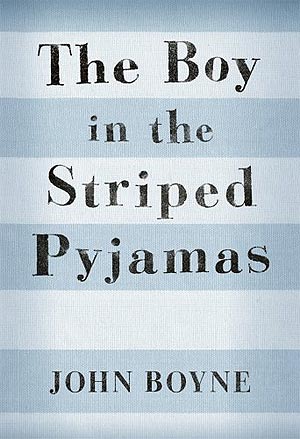
Reading: 'The Boy in the Striped Pyjamas'


'The Boy in the Striped Pyjamas' is a 2006 novel by Irish novelist John Boyne. Boyne is the author of 6 novels. Unlike the months of planning Boyne had for his other books, he said that he wrote the entire first draft of Boy in two and a half days, barely sleeping until he got to the end. To date the novel has sold more than 3 million copies around the world. In 2007 it was the best selling book of the year in Spain.

.

Module 01. Writing: Email (Students' mistakes)

Study these mistakes from your emails. We'll discuss them in the following class on Wednesday.

1. Dear Jackie:
2. I'm writting you because...
3. [Cartagena] is sited in the southeast of Spain, in the sea coast.
4. It has many beachs and many roman ruins.
5. Comming back some details of my life...
6. He told me you are really interested in contact with a Spanish-speaking person.
7. We like sharing Saturday's lunch all together with my brother and sister in love.
8. Although, we go on holiday in family... to spend some more time together and enjoy as well.
9. Don't doubt about stay at home.
10. I'm in my middle thirties.
11. I'm married with a lovely man.
12. We often have fun in my parent's home.
13. We enjoy swimming in the beach.
14. If you ever get the chance to visit Cartagena you would be wellcome at home.
15. You must know that my name is X.
16. Cabo de Palos is a village near Cartagena out of the stress of the city.
17. At winter it turns out to be very boring
18. My age is 20 so I'm studying at the university.
19. My mother is a housewife, so is my father the only one who works out then.
20. I'll be waiting to hear from you.
21. My family would be proud of knowing you.
22. My parents like very much having foreing people close to know more about others cultures.
23. We like to do touristic visists so we can prepare severals to do with you.
24. It's long time I don't write to you!
25. I suppose you will have already your home redecorated.
26. Don't forget to phone me when you arrived!
27. That's an astonished coincidence. I've lots of books about Spanish's traditions.
28. It's easy to practice a great variety of sports like dive, trek, climb or to hang-gliding.
29. I think I can help you to improve your Spanish in order to do not get lost.
30. My birthday is on November.
31. My brother is ten years old, but it's looks like two years younger.
32. To conclude, I invite you to visit my city.
33. I'm looking for your answer.

Tuesday, 21 October 2008

Module 01. Extra: Collocations

Hi,

I just checked out the possible collocations for the word argument, and these are the results:


argument noun
1. angry discussion:
angry, bitter, heated, violent, big, argument
little, silly, stupid argument

2. reason supporting opinion:
basic, general, main, good, major, powerful, sound, strong, valid, compelling, conclusive, convincing, persuasive, plausible argument

Source: OXFORD Collocations Dictionary for students of English

The collocation 'plain argument', as some of you suggested in class, might also be possible, but I haven't found any reliable sources to verify it. If you find any good references on the Internet, do not hesitate to post your sources in the Comments section.

See you tomorrow!

Module 01. Extra. An International Conference

Hi all,

In case you are interested, here is the document concerning the activity 'An International Conference', which we dealt with in the class on Monday.

You can print out the whole document, read the information for each of the seven countries, and do Exercise 2) on your own. I've posted the key to the exercise in the Comments section for your convenience.

See you!

Banking English Course at the EOI Cartagena


Hi all,

Just a few lines in Spanish to let you know about some interesting information for all the English-learning community in Cartagena and surrounding areas:

Tan sólo informaros que, como ya viene siendo habitual en estos últimos años, a partir del próximo 29 de Octubre voy a impartir en la Escuela Oficial de Cartagena una nueva edición de mi Curso Monográfico de Inglés Bancario.

El curso está dirigido a cualquier persona con un nivel mínimo recomendado de Nivel Básico II (superado) o Nivel Intermedio I (cursando), y está especialmente recomendado a aquellas personas que trabajen en una entidad bancaria, o que estudien alguna titulación relacionada con el mundo financiero y las finanzas.

El curso tiene una duración de 30 horas, y se impartirá los lunes y miércoles, de 19.00 a 21.00 horas.

Si estáis interesados y creéis tener el nivel suficiente, o bien si conocéis a alguien interesado, no dudéis en informarles acerca de dicho curso.

Además, próximamente también tengo previsto impartir un curso de Inglés Básico para Negocios, así como una posible continuación al Curso de Inglés Bancario, según disponibilidad de espacio e interés que pueda haber en los destinatarios.

Podéis encontrar más información en la Secretaría del centro, o bien en la página de la escuela.

¿Qué mejor forma de enfrentarse a la crisis que con un buen curso de Inglés Bancario? :)


So, in case you are interested in the course, please let me know. As a reference, the three former editions (2006/07/08) were a complete success, and I'm sure this edition will also be 100% satisfaction-guaranteed!

See you!

Wednesday, 15 October 2008

English resources: www.freerice.com


FreeRice is a is a charity website where users play a various educational multiple-choice games in order to raise money to fight world hunger. The games include chemistry (basic and intermediate), multiplication tables, English vocabulary (the game the site began with), English grammar, basic foreign language vocabulary for English speakers (French, German, Italian, and Spanish), geography (world capitals and country identification), and art.

Visit FreeRice, and somewhere in the world, a person will be eating rice thanks to the help you provided.

Module 01. Lifestyles. Jenna Fischer Video

Watch the following video about Jenna Fischer, an American actress, and answer the questions below:


1. When does Jenna feel most comfortable?
2. What's her secret for being so beautiful?
3. What's the most beautiful city she's ever been to? What was she doing there?
4. What does Jenna like the most about people?

Use the Comments section to make notes of as much extra information as you may have understood.

Module 01: Strategies. The importance of a good pronunciation

Berlitz is one the most popular language agencies in the world. Have a look at one of their commercials:


- Can you explain the punchline of the joke?
- Did you find this commercial funny?
- Do you still believe that a good pronunciation is not so important as other aspects of languages (good grammar, rich vocabulary, etc.)?

You can use the Comments section to post your impressions, as usual.

Friday, 10 October 2008

Fun stuff: 'Do you speak English?'

'Do you speak English?'
'No, I don't, sorry'.


UPDATE: The video is fixed and working now!

Online radio stations

Hi everybody!

In case you want to improve your English by listening to real radio stations, here are some useful links:

Radio Vaughan is an online radio station in English, especially recommended for English learners. It deals with a great variety of topics, and there are also interviews, English lessons and reflections upon the English language. Radio Vaughan also releases their programmes in MP3 format so that you can practice anywhere, any time... :)

Spectrum FM / REM fm is another radio station in English that can be tuned in most areas of the Costa Calida (92.7). Of course, you can also listen to the station online.

I'm sure there are some other local stations in English. I'll let you know when I remember their names! :)

Hope you enjoy them.

Wednesday, 8 October 2008

Module 01. Extra Grammar: Present/Past States

Complete the gaps with the correct verb tense. Then check your answers using the key in the Comments section

PRESENT STATES
1. The coffee ______________ (taste) bitter.
2. Ring his home number. He ______________ (be) at home now. (I’m sure he’s at home)
3. Tom ______________ (always go) away for weekends and he hardly ever sees his parents.
4. How much ______________ (I owe) you?
5. It’s no use asking Tom; he ______________ (not know).
6. The director ______________ (see) the applicants this morning.
7. ______________ (Bill be) at the club now? What do you think?
8. ______________ (it smell) sour?
9. I ______________ (always make) that mistake!
10. A: I can’t find Jude’s new address. B: Ask Tom; he ______________ (know) it.
11. Let’s not go shopping now. The shops ______________ (be) very crowded.

PAST STATES: USED TO / WOULD

1. I __________ smoke cigarettes.
2. He ___________ drink beer.
3. Every time she _____________ (come) home she _____________ (sit) on the couch, drink a cup of tea and talk about her illness.
4. _____________ (you live) abroad?
5. Tom and Ann _____________ (be) a young married couple. Every morning Tom _____________ (kiss) Ann and set off for work. Ann _____________ (stand) at the window and wave goodbye. In the evening she _____________ (welcome) him home and ask him to tell her about his day.

Tuesday, 7 October 2008

Module 01. Grammar: Present Habits

Put the verb in the correct form.

1. I ____________ (always go) to work by car.
2. You ____________ (always watch) television. You should do something more active.
3. John is never satisfied. He ____________ (always - complain).
4. The train is never late. It ____________ (always - leave) on time.
5. My parents ____________ (live) in Bristol. They were born there and have never lived anywhere else.
6. I used to drink a lot of coffee but these days I ____________ (prefer) tea.
7. Air ____________ (consist) mainly of nitrogen and oxygen.
8. George says he’s 80 but nobody ____________ (believe) him.
9. Who is that man? What ____________ (he want)?
10. ____________ (you see) that man over there?
11. This room ____________ (smell). Let’s open a window.
12. You look serious. What ____________ (you think) about?
13. I ____________ (think) of giving up my job.
14. Ann ____________ (not seem) very happy at the moment.
15. How ____________ (you feel) now?
16. I ____________ (usually go) by train, but this weekend I ____________ (go) by bus. It ____________ (take) longer but it ____________ (cost) less.
17. Mrs Jones: My daughter ____________ (never write) to me so I ____________ (never know) what she ____________ (do). ____________ (Your son write) to you, Mrs Smith?
Mrs Smith: Yes, I ____________ (hear) from him every week. He ____________ (seem) to like writing letters.
18. These apples ____________ (cost) 40p a bag. ____________ (You think) that is expensive? – It ____________ (depend) on the size of the bag.
19. I ____________ (see) my solicitor tomorrow (I’ve arranged it); I ____________ (change) my will. – You ____________ (always change) your will. Why ____________ (you not leave ) it alone?
20. I ____________ (not think) your brother ____________ (enjoy) the party. He ____________ (keep) looking at his watch.

Courtesy of Carmen Saura

Tuesday, 30 September 2008

Intermediate Level Revision: Pronunciation of -ed

1. Classify the following verbs according to their pronunciation in the past simple tense, that is, /d/, /t/ or /id/. There are ten answers for each column.

allowed - asked - cracked - cried - damaged - decided - encouraged - ended - flooded - guessed - included - jailed - killed - landed - loved - missed - mixed - pasted - relaxed - repeated - shaved - slipped - stopped - tasted - visited - wasted - washed - watched - welcomed - yawned

2. Complete the rules for the pronunciation of regular verbs in the past.

a. When the regular verb ends in a vowel sound or voiced consonant sound, the -ed ending is pronounced /_____ /.

b. When the regular verb ends in an unvoiced consonant sound, the -ed ending is pronounced /_____ /.

c. The -ed ending is pronounced /id/ when the verb ends in the consonant sounds _____ and _____ .


In case you need more practice with regular verbs, have a look at this website if you want to test yourself. Remember, try to read out the verbs to practice your own pronunciation as you progress with the exercise:

http://club.telepolis.com/phonetics/afoneticedd.html

Saturday, 27 September 2008

Photocopy donations

Hi again,

Please let me remind you that a donation of 4€ is felt to be necessary in order to cover for the expenses derived from the extra photocopies you'll be getting throughout the course.

I'll be collecting all the students' donations in one single envelope which will be taken to the photocopy room. Please feel free to hand in your donations at the beginning/end of the class or during the break.

Cheers

Textbooks and resources for NA1

Hi all!

These are the books we'll be using during the year 2008-09:

First Certificate Expert NEW EDITION (Student's Book) (Longman)*


* Please note bookshops are starting to sell the newest edition of the book (i.e. the one with the text 'NEW EDITION' and 'With December 2008 exam specifications" on the upper-right side corner).

In case you purchased the old edition, please return the book to your bookshop and exchange it for the new one, as the contents inside are quite different from each other.

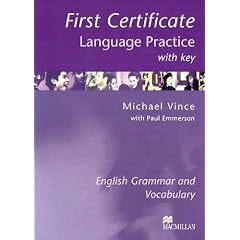
First Certificate Language Practice (with key) (MacMillan) **


** The editions of this grammar book may vary. If you have a previous edition you do not really need to buy the newest one, as most of the contents may be similar.

As I said before in class, the Grammar book is to be done independently as we progress in the course, so you do not need to take it to class every day unless you feel like doing so.

Recommended readings: To be arranged.

Saturday, 20 September 2008

Welcome

Hi everyone,

First of all, a warm welcome to all those NA-1 students who have decided to visit this blog. Here you will find useful information regarding the contents seen in class, along with extra activities, audio and video in English, and lots of useful things so that you can practice on your own outside the classroom.

Please, stay tuned and visit us regularly for more details.

See you soon!